 Field · Northland traplineKerikeri · deployment activeProven
 Field · dairy farmValidating · 2026Validating
 Environment · water storageCore-readyCore-ready
 Environment · back countryField testing nextCore-ready
Ghost Systems NZ reads what moves through an environment: detecting presence, monitoring conditions, protecting what matters.
Ghost detects what moves through an environment without disturbing it, builds a library of what it sees, and that library grows with every deployment.
Field · Northland traplineKerikeri · deployment activeProvenField · dairy farmValidating · 2026ValidatingEnvironment · water storageCore-readyCore-readyEnvironment · back countryField testing nextCore-readyGhost classifies what moves through the field without recording who is there. No image data. No audio of speech or human activity. Ghost Ear, where deployed, listens for insect-scale acoustic signatures and species vocalisations in conservation contexts only. Data belongs to the operator.
A Ghost node establishes a Ghost field around its deployment geometry. A calibrated quiet floor is recorded at installation · everything Ghost detects is measured as change from that baseline.
When the field is altered by movement or change in the environment, the deviation is read against the quiet floor and passed to the behaviour library for matching.
Pattern matching against Ghost's behaviour library identifies the class or event type · predator, livestock, environmental shift, fall, boundary crossing.
Detection events push to your phone, email, or Ghost Library Dashboard in real time. Every alert shows when it happened and which node registered it.
Every confirmed detection strengthens the behaviour library for all Ghost users. The more Ghost is deployed, the more its library covers across every environment.
Every Ghost application runs on the same passive field physics · calibrated per environment. Scroll through the divisions · each opens as you reach it, drawn the way it reads in the field: the node, the Ghost field, and the target as a classified signature.
90+ applications identified · thirteen divisions · expanding
Illustrations are schematic. Production Ghost nodes are compact sealed units; illustrated sizes are exaggerated for visibility.
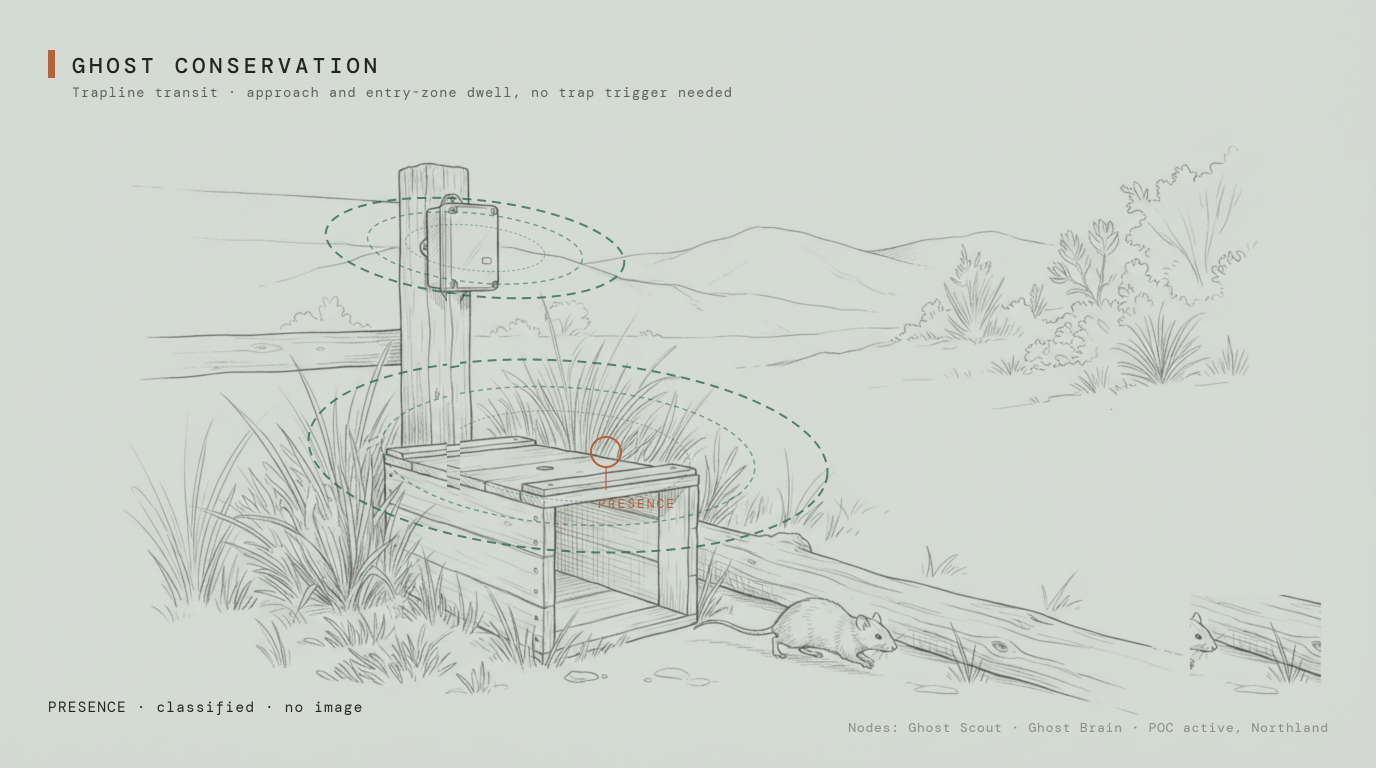
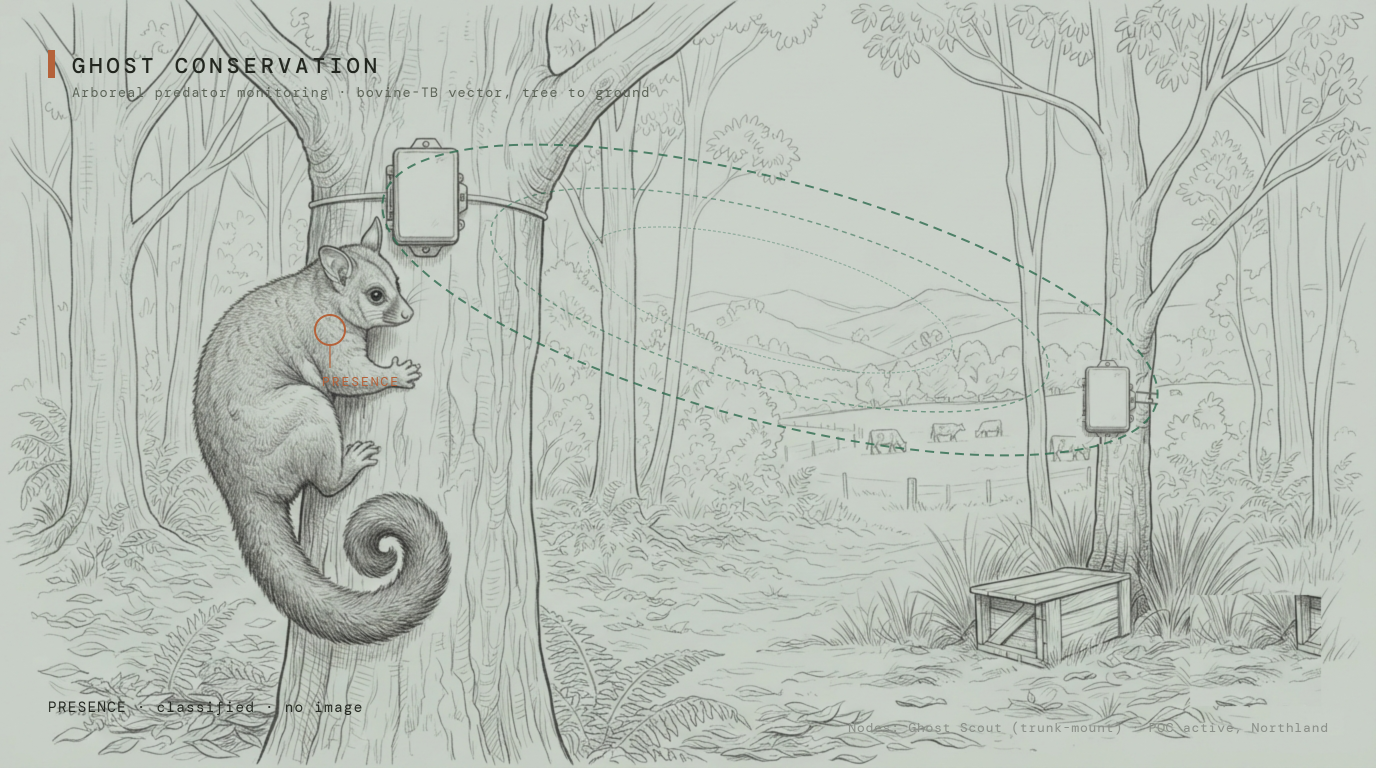
Predator transit and trapline activity classified without cameras or trap triggers. Ghost Scout at 100m intervals detects approach, entry-zone dwell, and kill-confirmation signature · the spacing that covers a standard conservation trapline.
Ghost Ear adds species vocalisation monitoring at acoustic waypoints; Ghost Brain at the trailhead aggregates events and alerts coordinators · no site visit required between trap checks.
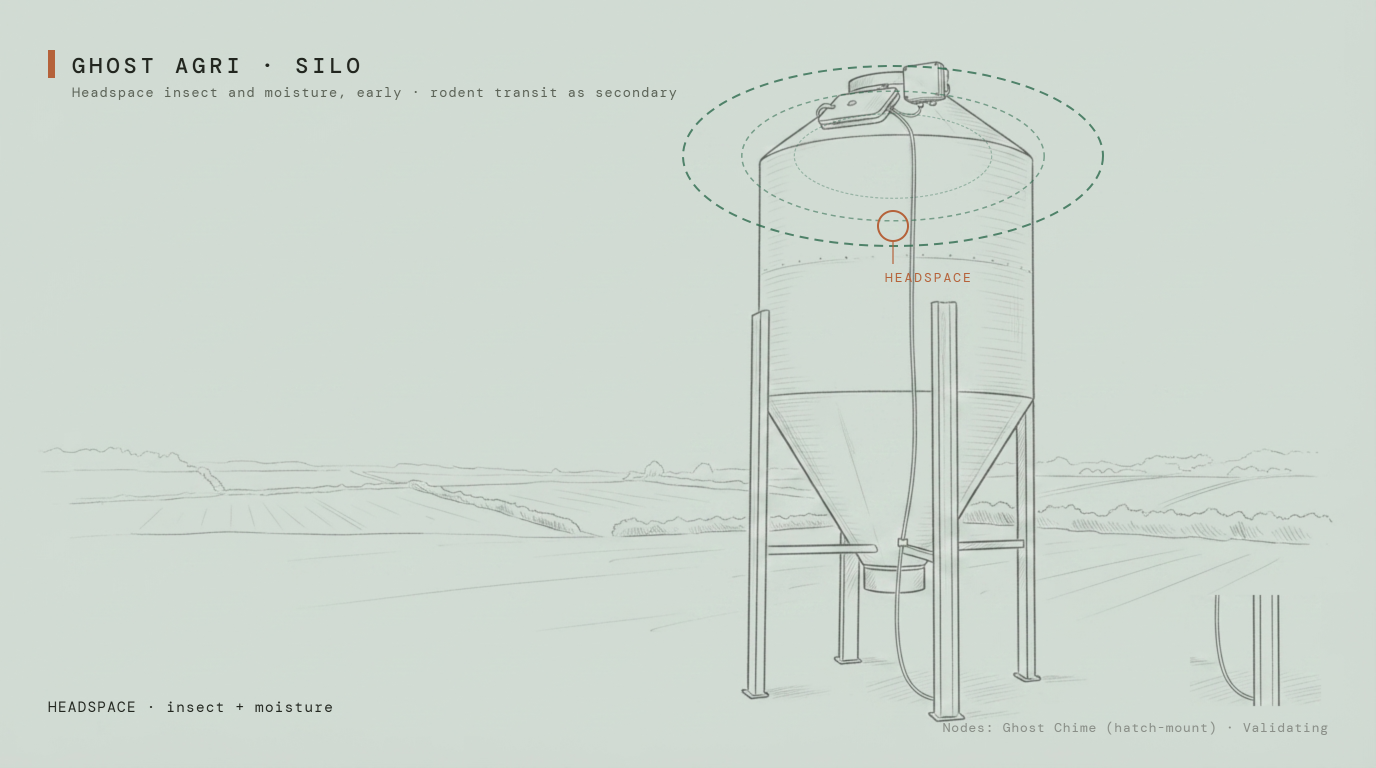
A single Ghost Chime node mounts through the hatch of a dairy feed or grain silo · nothing touches the stored product. Its primary value is catching insect activity and moisture in the headspace early, where infestation and spoilage begin; rodent movement is registered as a secondary capability.
The same node resolves fill level passively from the absorption profile of the feed surface. One cable. One node. No probes, no food contact.
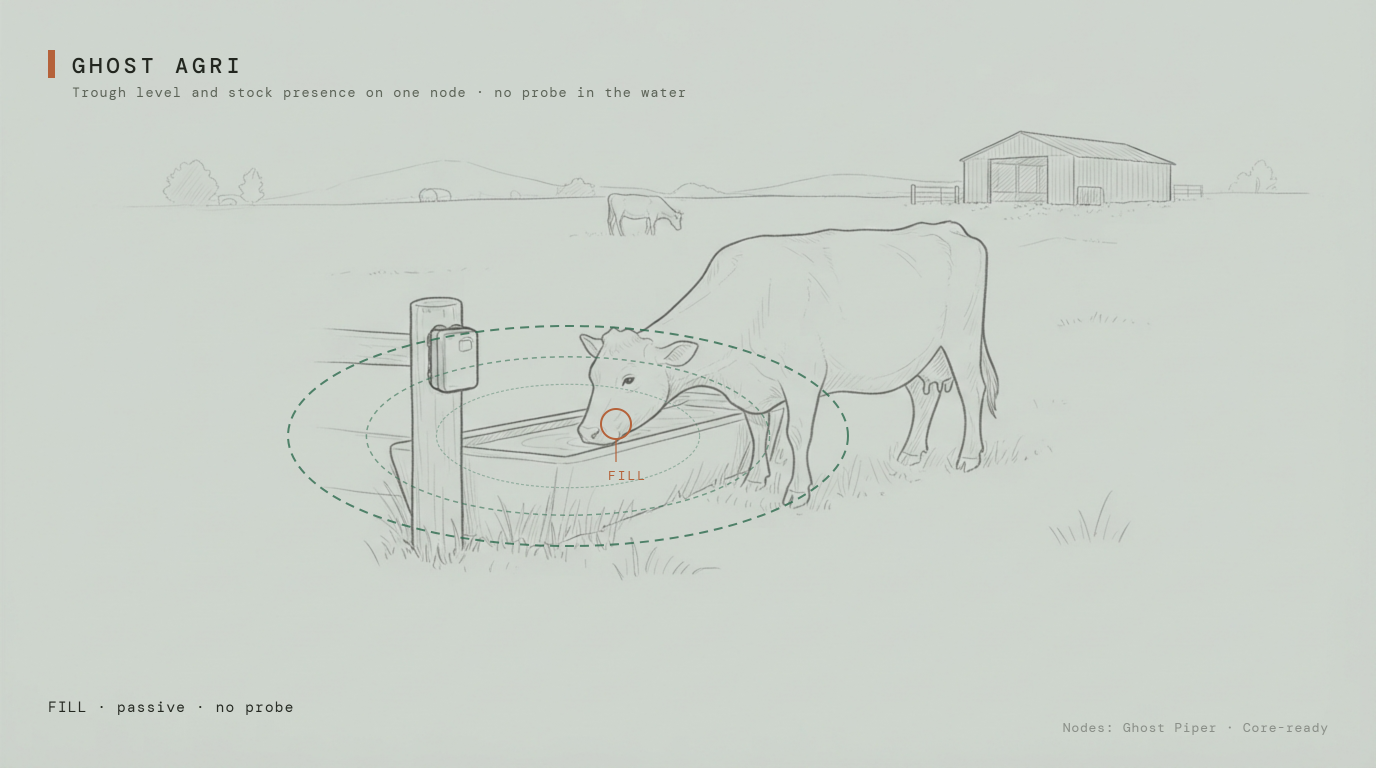
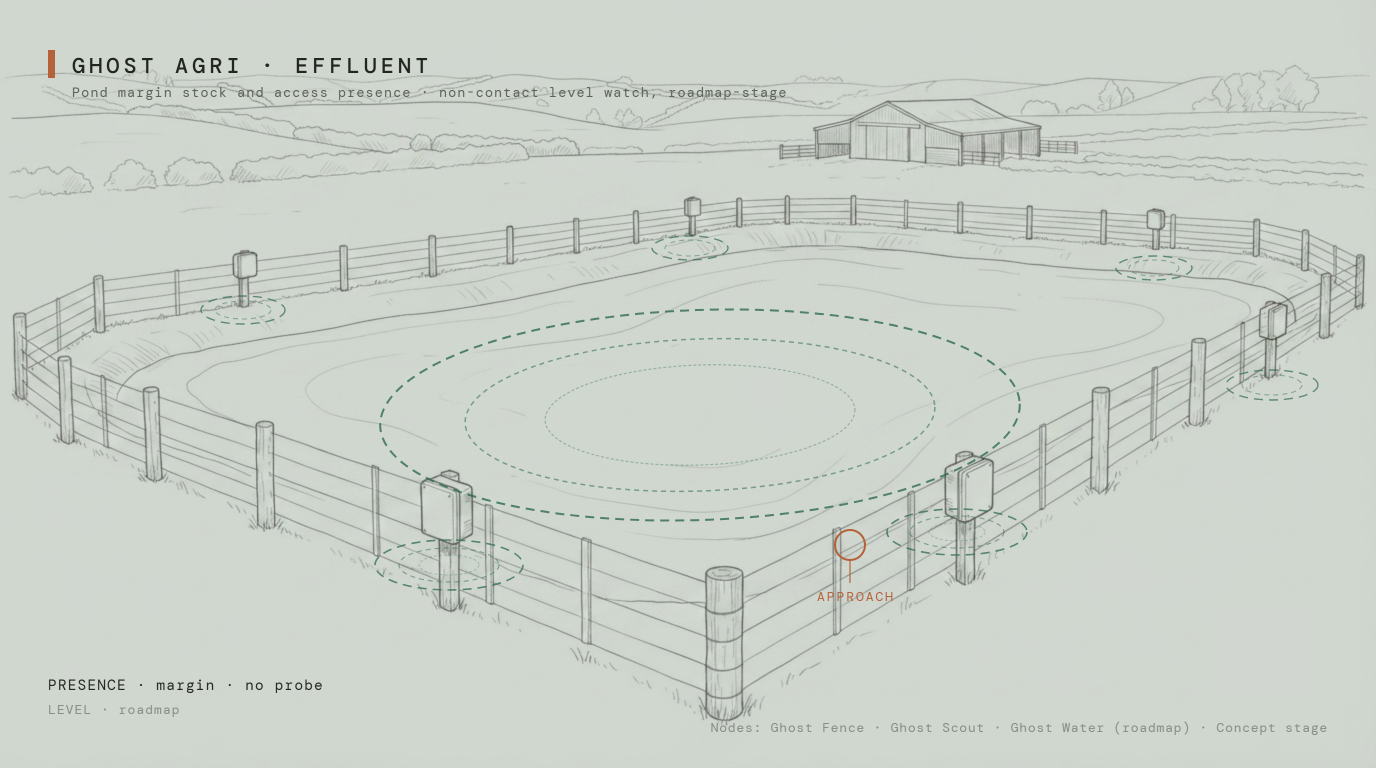
Trough, tank and reservoir level without a probe in the water, plumbing change, or continuous power. Ghost reads the fill level from the absorption profile of water at that geometry · calibrated at installation.
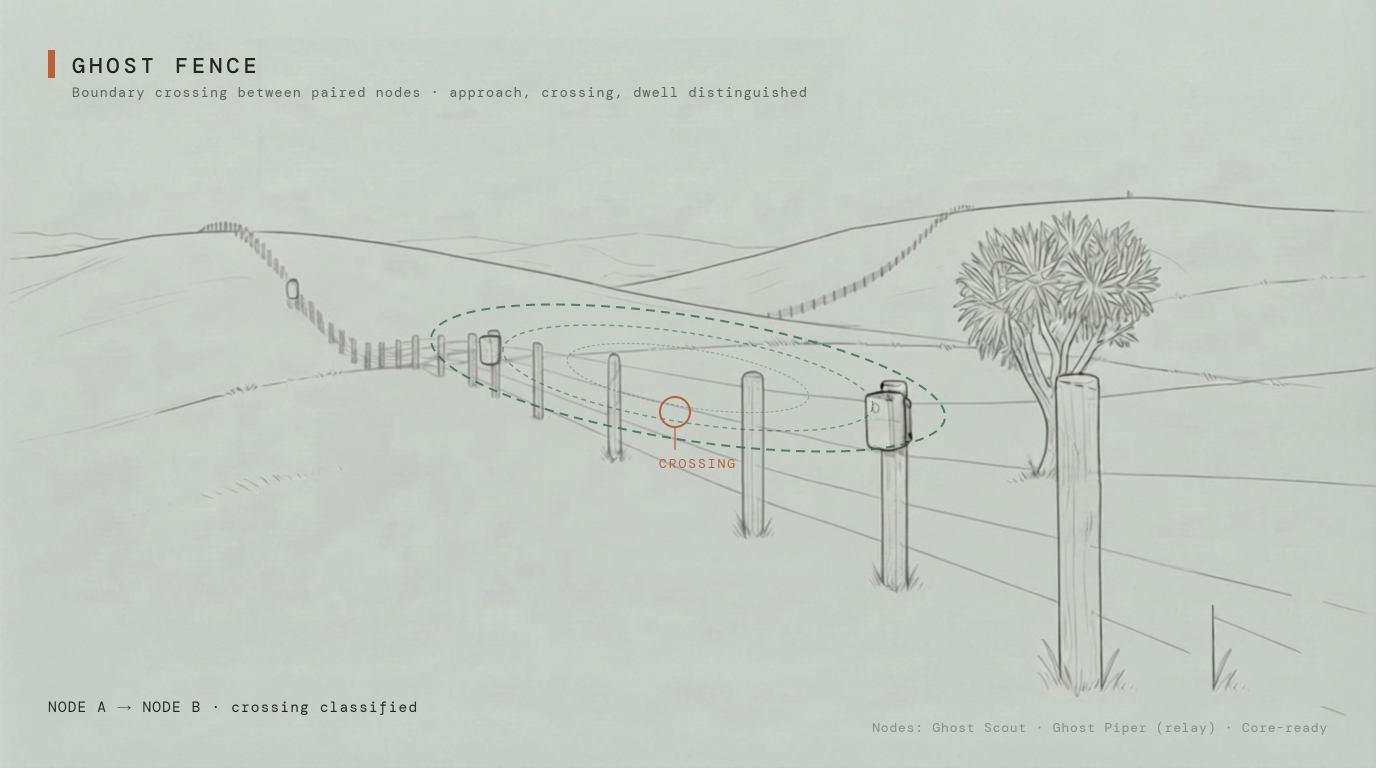
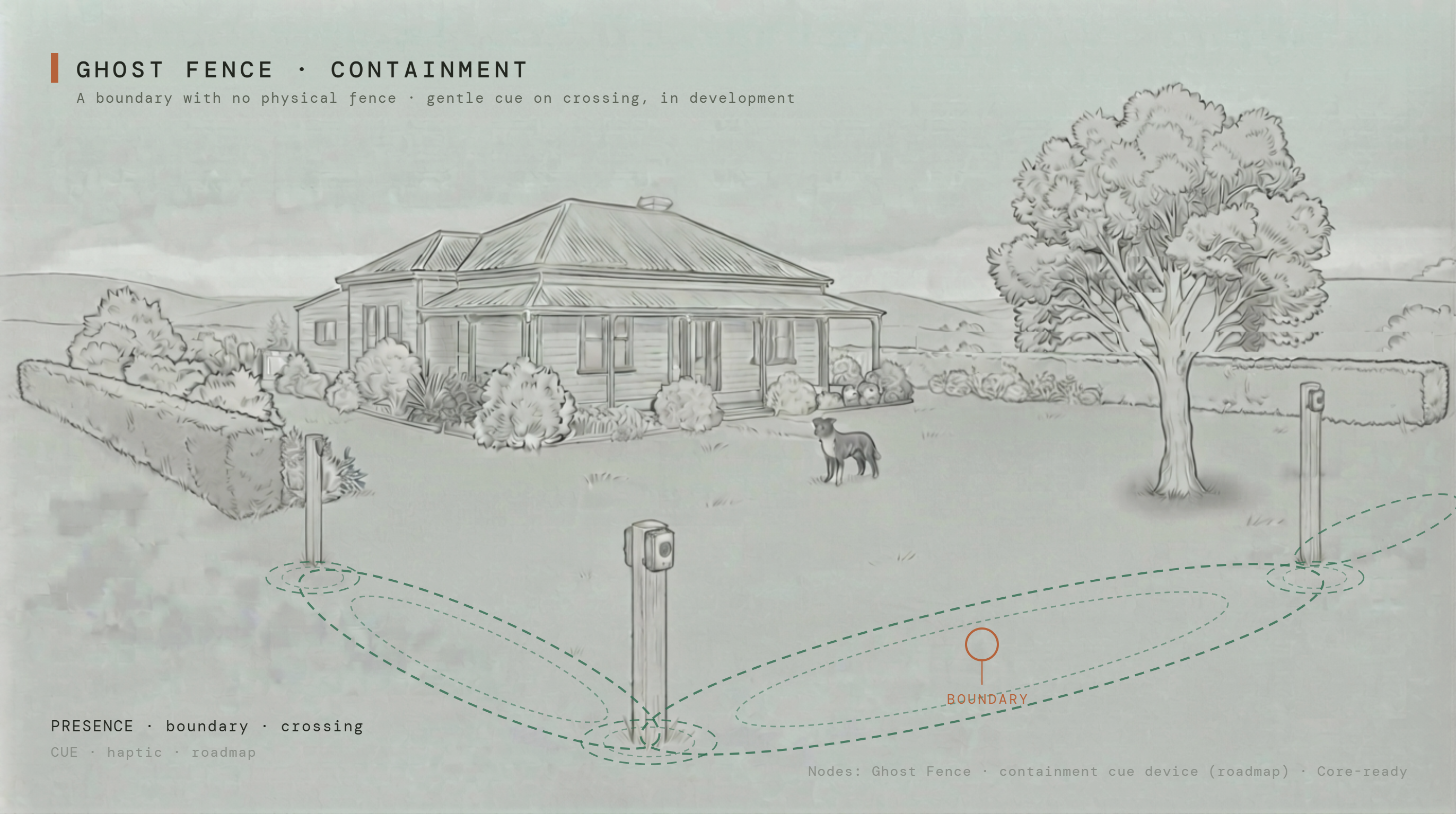
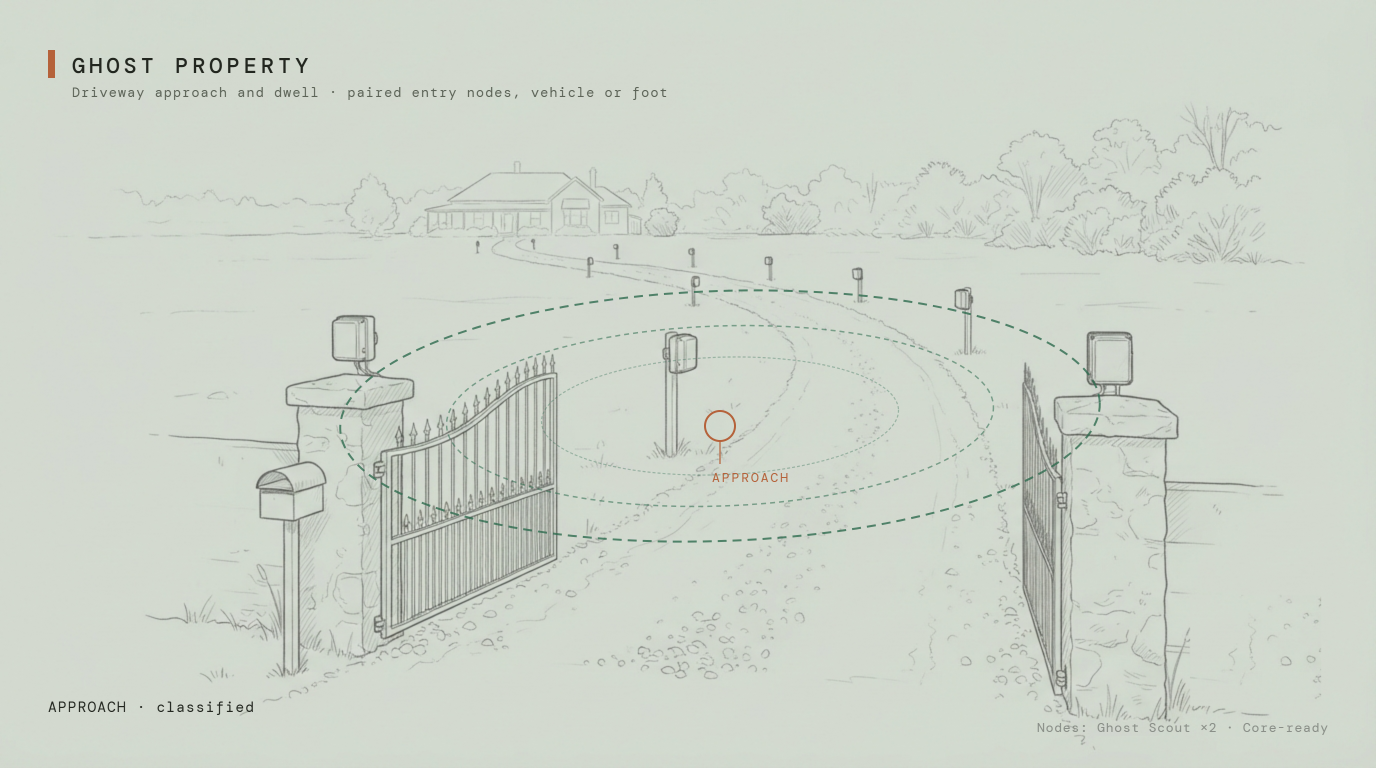
Two Ghost nodes at either end of a fence span create a passive detection zone between them. Approach, crossing, and dwell at a property boundary · livestock, pets, predators · with no contact with the boundary itself.
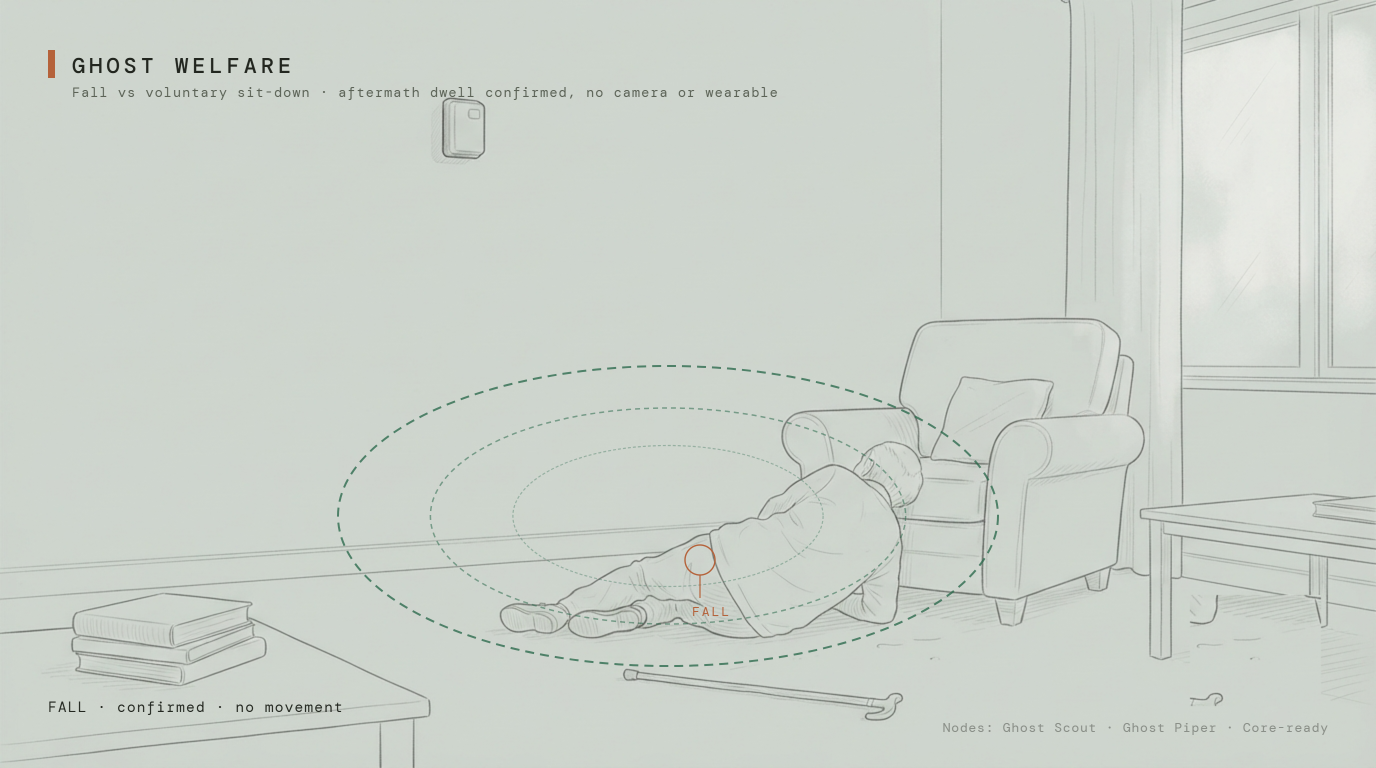
Fall detection with aftermath-dwell confirmation · distinguishes a fall from a voluntary sit-down. No camera, microphone, or wearable. Ghost reads the geometry of the event and the sustained-dwell period that follows.
Dignity-preserving by architecture: Ghost cannot record or transmit who is in the room, only that something fell and has not moved since.
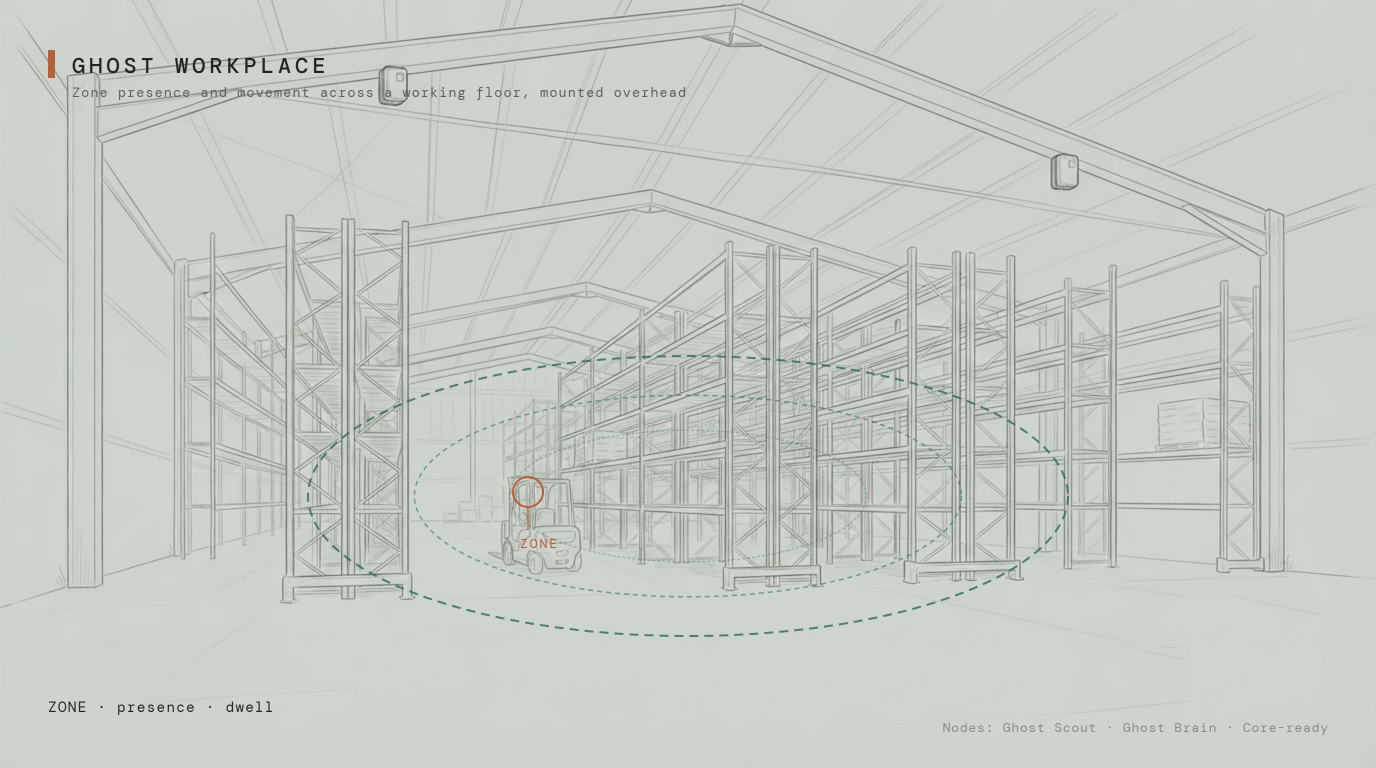
Room and building presence · something is here, where, and for how long. Never who. Ghost detects approach vector, zone entry, and dwell time. Cameras can be disabled or covered; Ghost cannot be obscured by tampering.
Ghost notices. Nothing watches.
Zone presence and movement across a working floor, mounted overhead. Where and for how long · never who.
Driveway approach and dwell at paired entry nodes · vehicle or foot, classified at the gate.
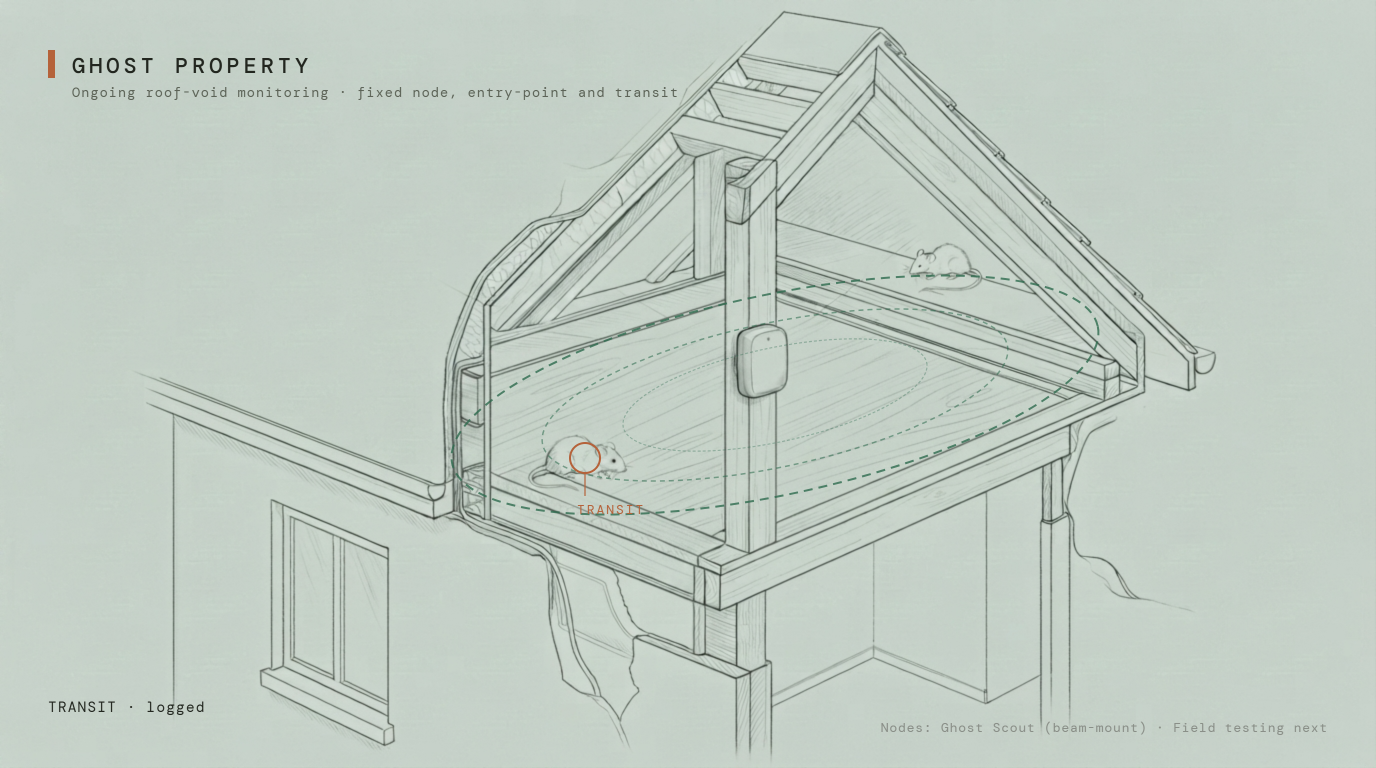
A portable unit reads pest activity and entry points during pre-purchase inspection; a fixed beam-mount node logs roof-void transit long-term.
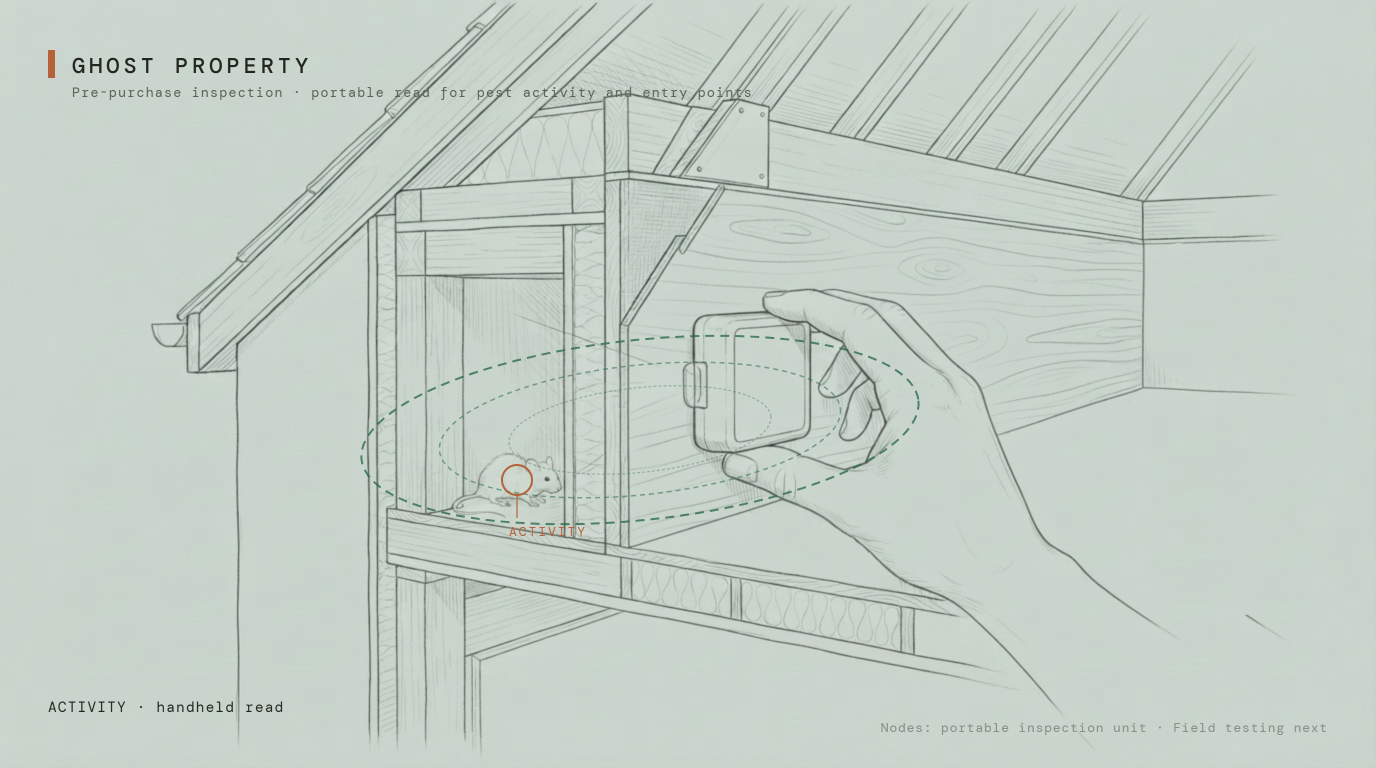
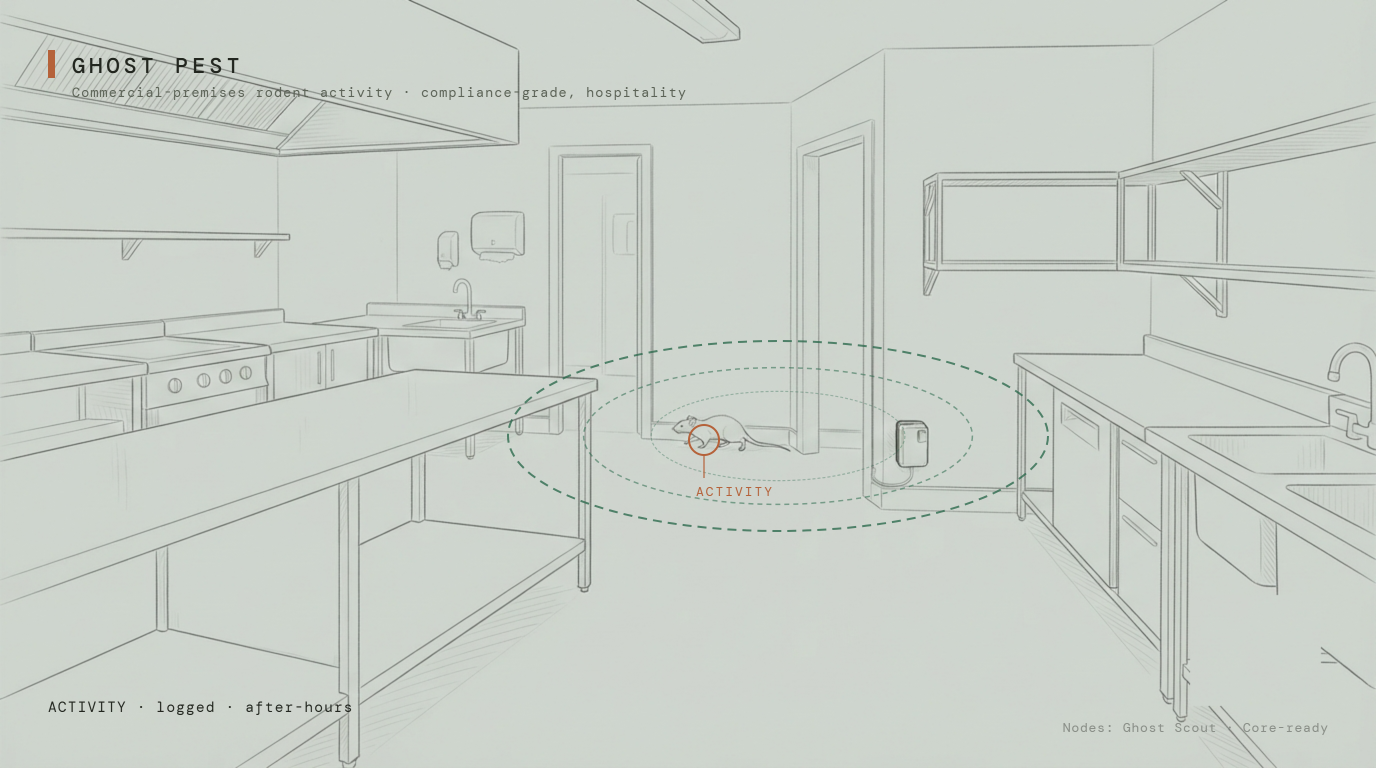
Commercial-premises rodent activity, compliance-grade · hospitality settings. Activity logged after-hours, no camera in the product.
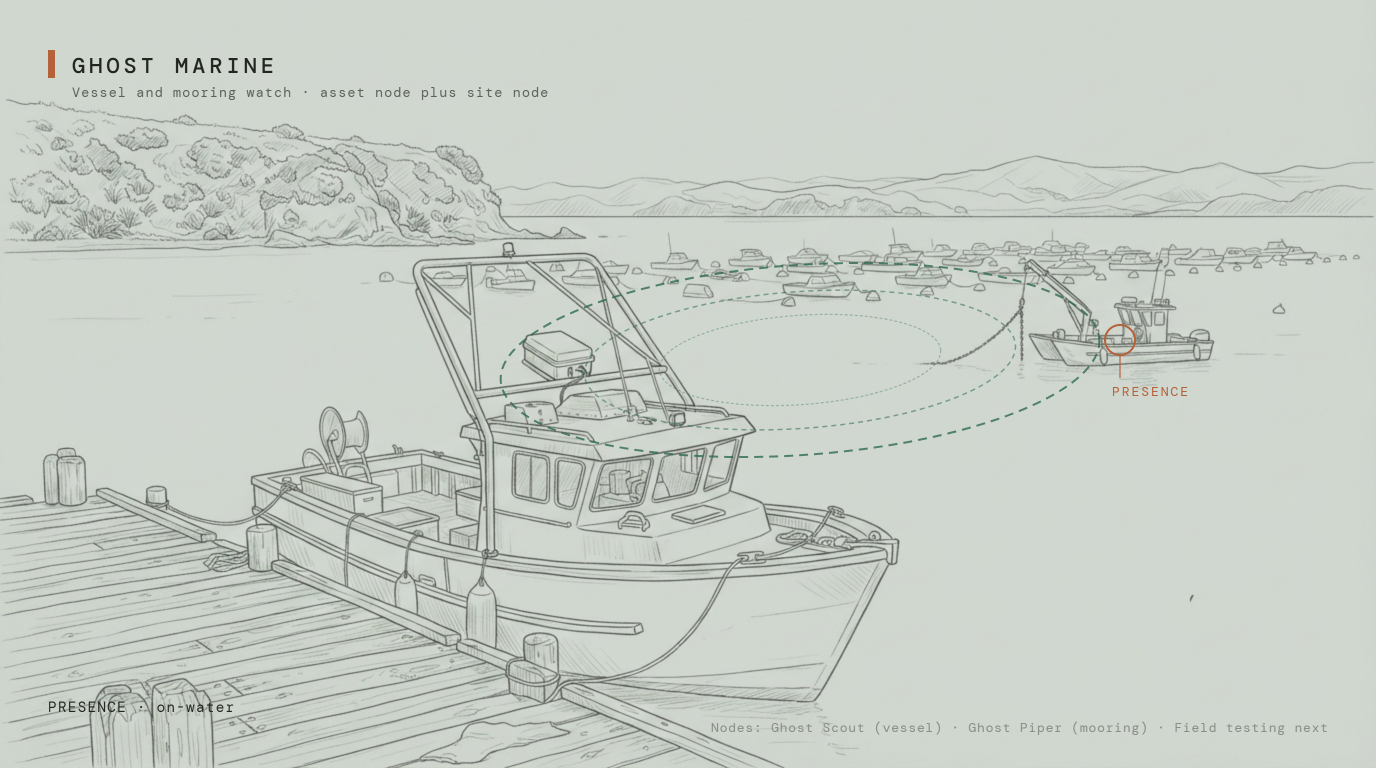
Vessel and mooring watch · an asset node aboard plus a site node at the mooring. Presence on the water, no image.
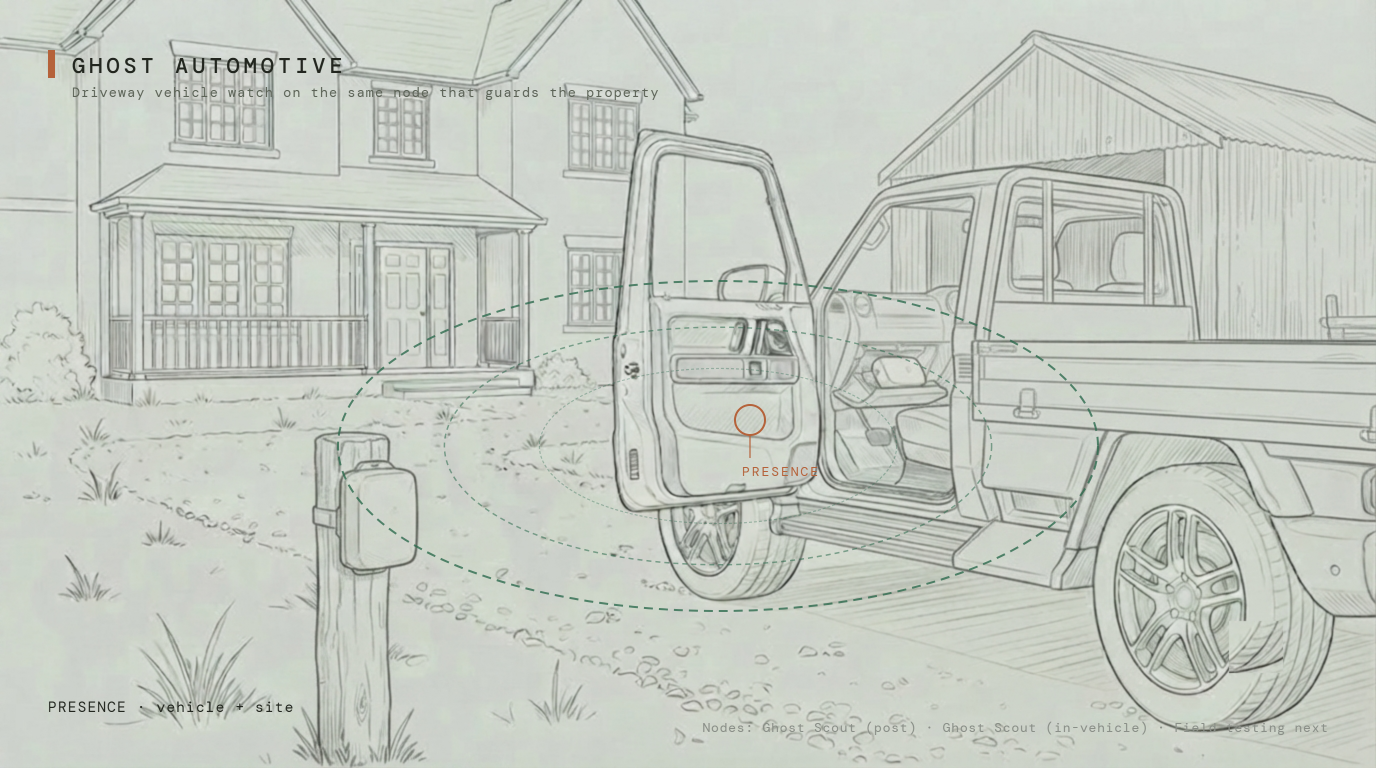
Driveway vehicle watch on the same node that guards the property · vehicle and site presence from one install.
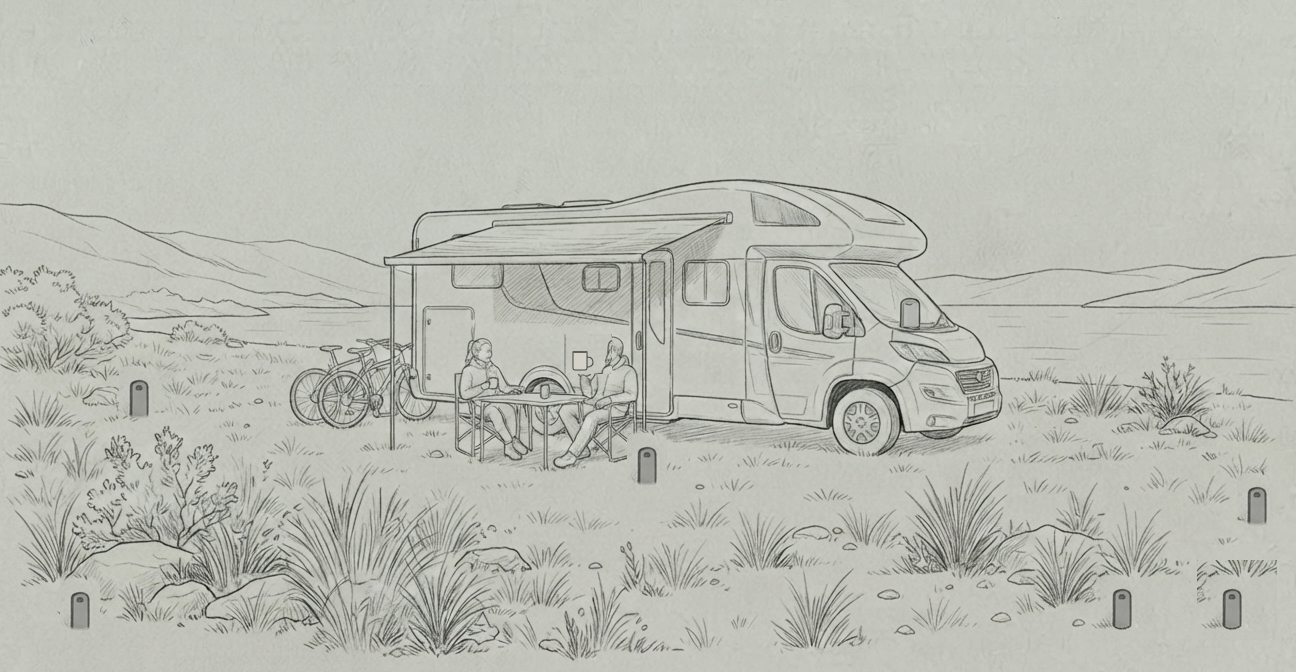
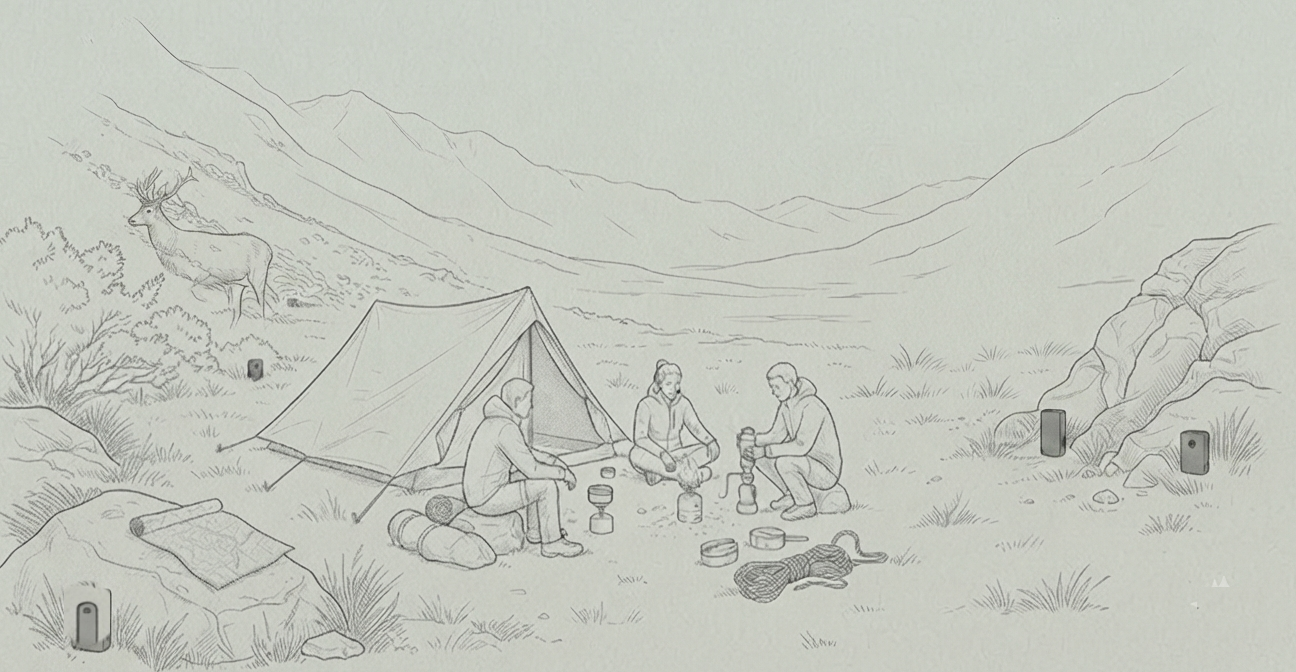
Ghost Adventurer places passive detection around a backcountry camp. Tent, cook site, and gear sit inside one field. Wildlife approaching at distance is classified before it reaches camp, with no camera, no light, and no sound.
Each unit works independently, calibrated to the ground it sits on. Placement is the only setup.
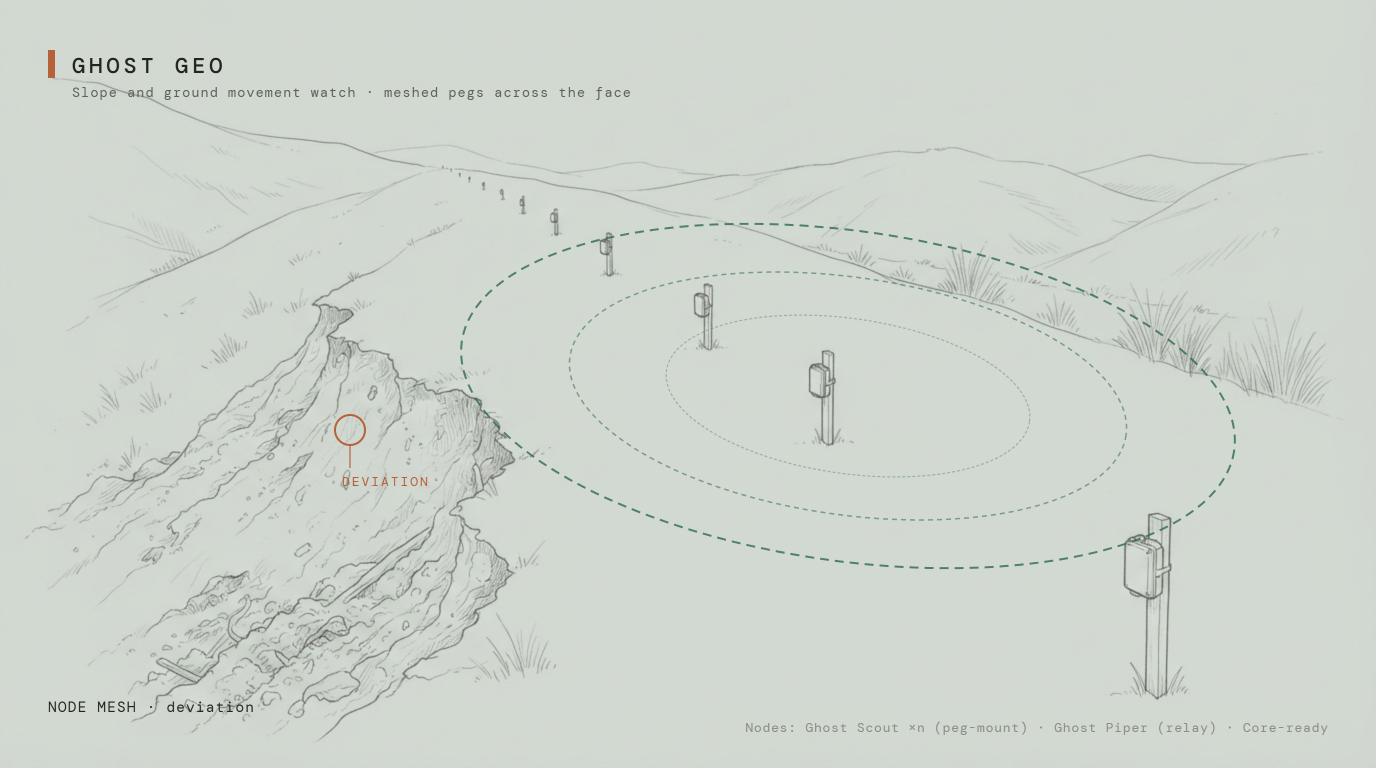
Slope and ground movement watch · meshed pegs across the face report deviation as it develops.
Every Ghost node is a mesh point. Multiple Ghost applications can run on the same deployed infrastructure simultaneously · a single installation can monitor for predators, check water levels, watch the fence line, and log silo conditions at the same time.
Ghost reads the Ghost field at each node. When the field is altered by movement or change in the environment, the deviation is matched against the behaviour library. A calibrated reference state · the quiet floor · is established at each site.
Ghost reads the field passively. It directs no signal at what it monitors and never actively probes it · Ghost detects, it does not illuminate, target, or disturb what it is watching. This is fundamental to its conservation application.
Ghost works alongside existing infrastructure across every application. A farm already has silos, troughs, and fences. Ghost adds a detection layer without replacing what is there.
The behaviour library grows with every confirmed detection, and compounds across applications.
| Node classes | Ghost Brain · Ghost Ear · Ghost Pulse · Ghost Scout · Ghost Piper · Ghost Chime |
| Operating mode | Passive · directs no signal at what it monitors; never actively probed |
| Power | Mains · Solar · Battery backup. Alerts on power interruption. |
| Connectivity | Long-range mesh backhaul · local data log · cellular optional |
| Alert delivery | Real-time push notification · email · Ghost Library Dashboard |
| Field-confirmed | Rat and mouse, confirmed across 11 recording sessions · target species library expanding |
| IP status | Patent pending · Craig Forsyth, Ghost Systems NZ |
| Infrastructure | Works alongside existing systems · does not require replacement of current monitoring infrastructure |
Predator transit and dwell events logged by Ghost alongside camera-trap footage of the same events. Ghost detected the presence; the camera confirmed the species.
Passive absorber curve validated across fill range without any probe in the water. Ghost resolved meaningful volume changes at the states where operational decisions actually matter.
A subject that had stopped moving was detected in grain silo headspace geometry and held as a continuous reading over an extended period · Ghost distinguishing a static body from an empty space. An early bench pass also detected vibration events within the grain headspace passively · an initial indication relevant to early insect activity.
Large-mammal approach, dwell-gate distinction, and boundary crossing distinguished at the bench, with real-time alert delivery. Outdoor range is in field testing.
Human transit and dwell-gate distinction confirmed at room scale. Fall geometry validated · Ghost distinguished a fall from a voluntary action without any camera, microphone, or wearable. Static presence monitoring · registering a person who has come to rest in a space · is part of the same design, with confirmation testing underway.
The public dashboard shows live Ghost Conservation field data and the species library from the Northland deployment. Partner and operator tiers add full event detail on request. View the live dashboard →
Ghost is in active conversation with conservation organisations, agri operators, and research institutions across New Zealand · and building toward Australia and the United Kingdom.
craig@ghostsystems.co.nz